
ChristianCafe vs eHarmony vs ChristianMingle Side-by-Side Editorial Review, 2026
By Nicole Foster, Review Editor. Updated May 2026
Advertiser Disclosure: This site contains affiliate links. We may earn a commission on purchases – this doesn’t affect our editorial ratings. Read more
If you’re dealing with shallow matches on mainstream apps, denominational mismatch that turns into wasted conversations, or the recurring cost of hopping between paid subscriptions that still do not feel faith-centered — you’re not alone. Most Christian singles know their dating life needs attention, but with dozens of Christian dating apps on the market all claiming to work, it’s hard to know what actually delivers.
The editorial team spent weeks researching the ChristianCafe, eHarmony, ChristianMingle and other Christian dating sites, analyzing hundreds of customer reviews, and comparing the faith filters, profile depth, and relationship-intent tools behind each platform. These are the 3 that consistently stand out for serious Christian dating — and our #1 pick uses a Christian-only member community with detailed faith and lifestyle profile fields that the others do not match in the same way.
✓ Independent Reviews. ✓ No Sponsored Rankings
Our rankings reflect editorial judgment based on research, product positioning, and typical use cases. Different dating sites may be better suited to different needs, conditions, or budgets.
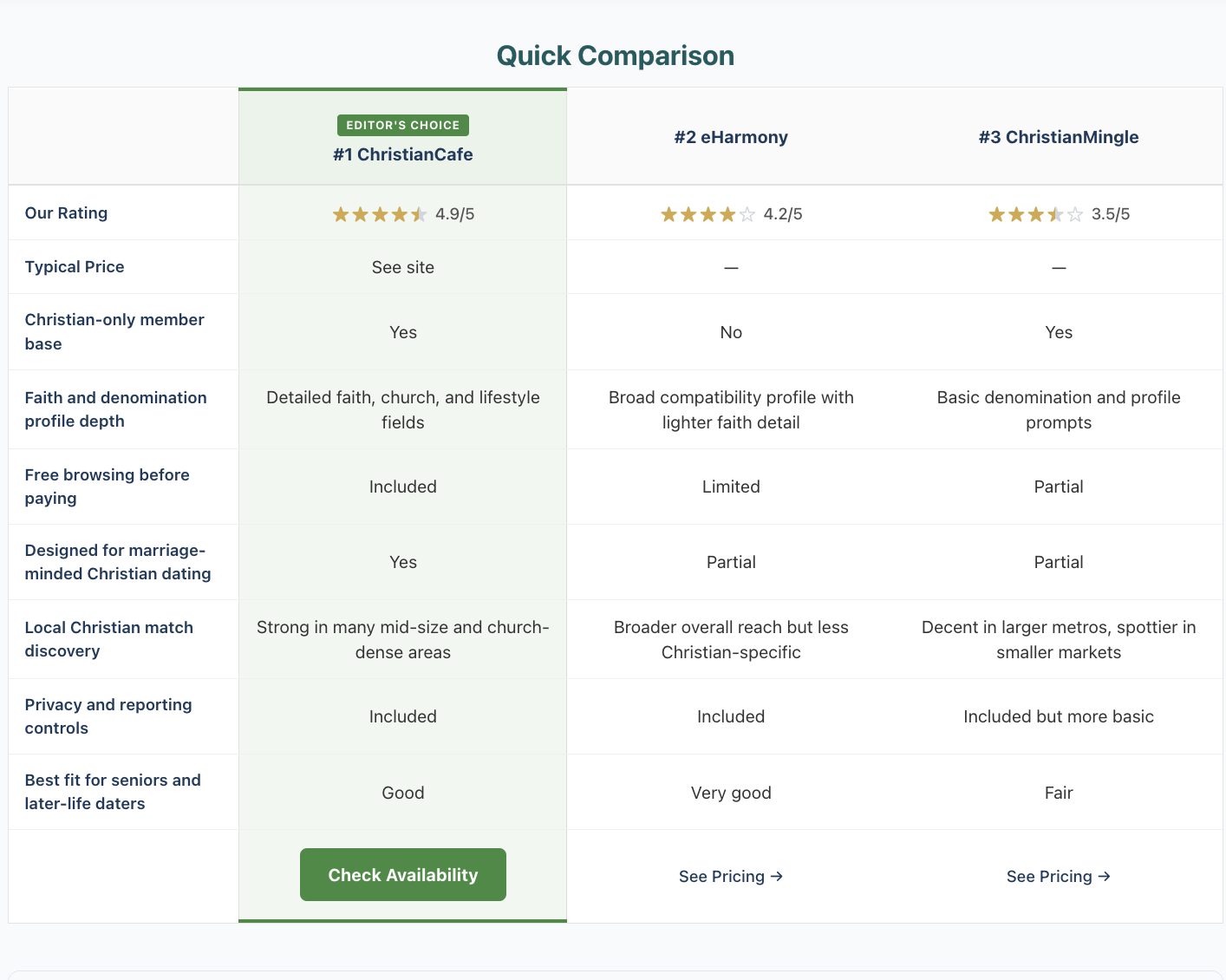
Quick Comparison
How we evaluated these products.
These rankings are based on editorial research into features, pricing, public-facing policies, and customer feedback patterns. There was no lab testing, no independent verification of customer reviews, and ratings reflect editorial judgment.
Faith-specific filtering
Serious-relationship signaling
Profile depth for compatibility
Low-risk first step
#1 Best Overall ChristianCafe
Why ChristianCafe Stands Out
Our editorial team’s top pick for Christian dating.
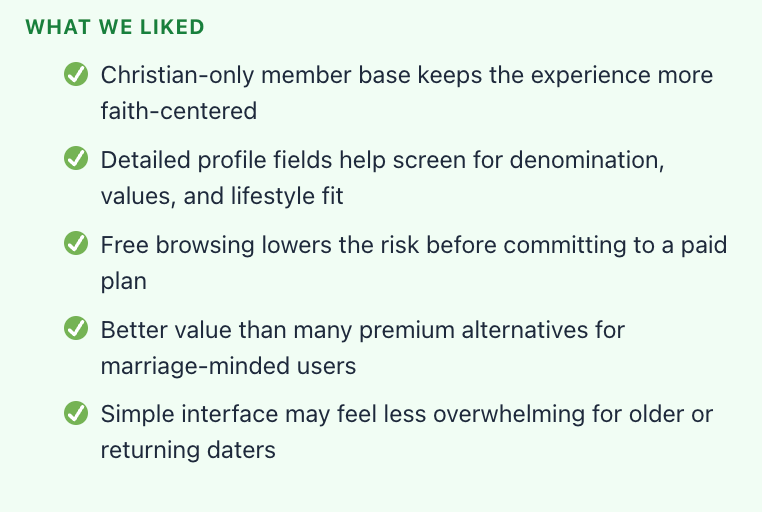
ChristianCafe stands out as the strongest fit for people who want a faith-first community rather than a general dating platform with a Christian filter added on. Its biggest advantage is focus. The site is built around Christian singles dating, detailed faith profiles, and a more intentional tone that many customer reviews describe as calmer and more serious than mainstream-style apps. It is not the flashiest option, and local activity can vary, but the balance of faith alignment, browse-before-upgrade value, and relationship-oriented positioning makes it the best starting point for many Christians interested in dating.
ChristianCafe has been connecting believers for longer than most of its competitors have existed. It has quietly taken credit for over 25,000 marriages in that time. It isn't the biggest name in Christian dating, and it isn't trying to be. What it's trying to be is a place where members can find faith filled love that lasts a lifetime. If that fits your priorities, then this difference matters more than anything else.
Profile prompts invite users to describe their faith journey, list meaningful scripture verses, and reflect on what they're looking for in a partner spiritually. Denomination filters cover 34 options, more than any competitor. Search selection criteria include church involvement levels such as "attends regularly," "very involved," or "leads a ministry."
Faith depth options range from "it defines who I am" to "still figuring it out," and these filters apply to both your own profile and how you search for others. There's also a Community tab with prayer request boards, devotional content, and faith-focused forums — features that have no equivalent on ChristianMingle or eHarmony, and that speak plainly about what kind of community this platform intends to be.
For users who have felt burned by platforms where "Christian" is a self-applied label that doesn't survive a second conversation, ChristianCafe's structure is a genuine relief. The environment self-selects for people who chose a faith-specific platform on purpose.
How Christian is it, really?
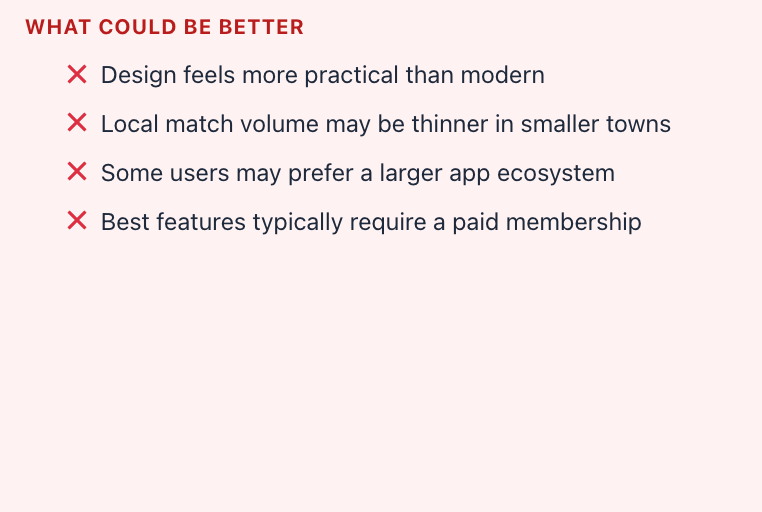
User Experience is straightforward, with a somewhat dated design
The interface is straightforward and easy to navigate. Sign-ups take around 5 to 10 minutes. The user profile setup is clear, and finding search settings is also straightforward.
But the website design is plainly dated, the mobile app is more limited than the desktop version (forums and prayer boards are desktop-only), and there's nothing here that could be called slick.
But, the platform gives users more control than eHarmony's algorithm-driven matching. Members can browse and message anyone freely, there's no waiting for the system to deliver curated matches. The QuickMatch feature comes up with compatibility percentages based on faith, age, location, and relationship goals, but it's a tool, not a gate. Users aren't locked into it the way eHarmony members are locked into their delivered matches.
You should know that administrators do review communications, especially for new accounts. Some users appreciate this as a safety measure, but others may find it intrusive.
The mobile app holds up well for searching and messaging but doesn't include the community features that make ChristianCafe special. Users who value the prayer boards and forums need to rely on the desktop experience.
Pricing and Value
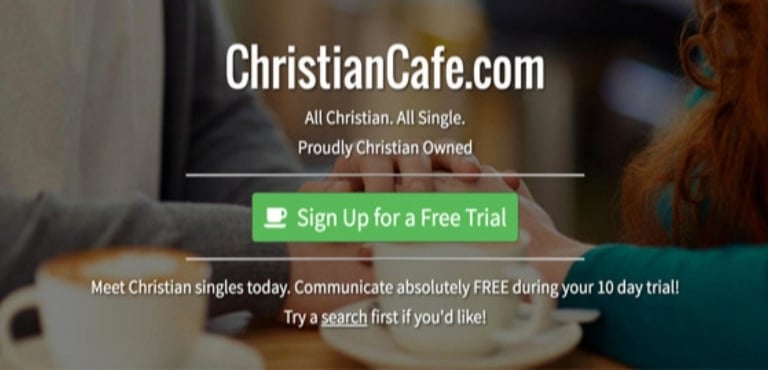
ChristianCafe's approach to pricing is, refreshingly, one of its most user-friendly qualities. The platform offers a truly free trial, 7 days automatically, and 10 days if you post a profile photo. The free trial period includes full messaging access with no credit card required.
ChristianCafe's free trial is a rarity for dating sites and apps. And it solves the most practical problem facing any new dating site user, letting you check how many active Christian singles are on the site in your area, before you spend any money.
After the free trial, paid plans run approximately $44.97 for one month, $69.97 for three months, or $109.97 for six months. A 12-month plan brings the monthly cost down further. Unlike eHarmony, which requires a minimum six-month commitment and carries a no-refund policy on auto-renewals, ChristianCafe does not. This user friendliness is a detail that is much appreciated by users who have been stung by surprise charges elsewhere.
Payment can be made by credit card, PayPal, check, or money order, and the pricing is stated upfront rather than hidden behind a signup funnel.
On a per-month basis, ChristianCafe is comparable to ChristianMingle and a lot cheaper than eHarmony's short-term plans.
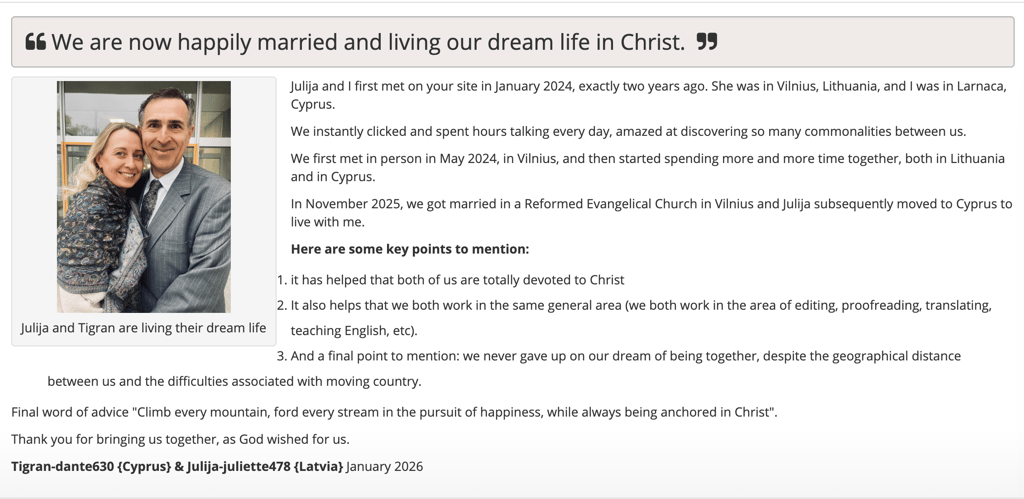
What verified members are saying.
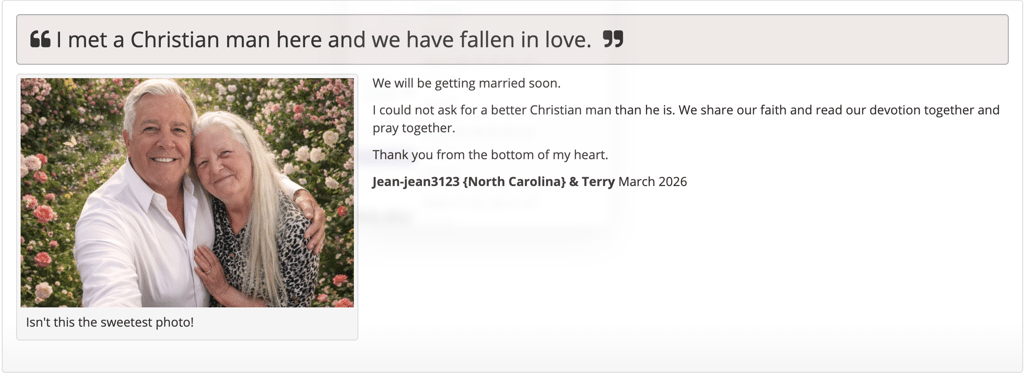
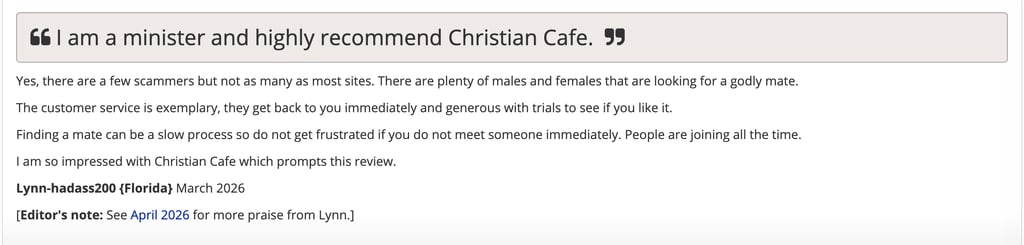

Source: Sentiment drawn from r/ChristianDating, r/christiandatingadvice, and r/ChristianSingles, as well as aggregated review and consumer sources. Pricing reflects reported 2025–2026 figures and is subject to change. ChristianCAFE does not conduct background checks on members.
Results vary; individual experiences may differ.
#2 Runner-Up: eHarmony
Premium alternative for christian dating


There's a popular myth floating around Christian singles communities that eHarmony is essentially a Christian dating site with a more polished interface. It's easy to see where that idea came from: eHarmony was founded in 2000 by Dr. Neil Clark Warren, an evangelical Christian clinical psychologist and former dean of Fuller Theological Seminary, and its early marketing leaned explicitly into faith-based relationships.
But here's the truth that commentors on r/ChristianDating and r/ChristianSingles will tell you fast. EHarmony is not a Christian dating site. Whether that matters to you, and how much it matters, is the real question.
eHarmony's Compatibility System: A Genuine Strength
Where eHarmony earns its reputation, even among skeptical Christian users, is the depth of its matching system. The onboarding questionnaire is seriously detailed. And long. Typically, it will take 30 to 45 minutes to answer all the questions. It probes values, lifestyle, emotional temperament, and relationship goals in ways that most dating apps don't even try to match.
Reddit followers on r/ChristianSingles who have tried both eHarmony and ChristianMingle frequently note that eHarmony's matches get a lot right, even if the faith filter isn't as tight.
The tradeoff is control. eHarmony's algorithm sends you your potential matches. You aren't allowed to just browse through profiles the way you might on a more open platform. For users who want to do their own searching and make their own calls, this can feel restrictive. On the other hand, if you feel exhausted by scrolling and swiping over and over again then you may be happy to trust eHarmony to use all the answers to their questionnaires for your best possible matches.
One thingChristian users say eHarmony gets right are the guided communication tools. They suggest structured icebreaker prompts rather than jumping straight to open messaging. Users find these prompts are good at encouraging more meaningful first conversations. That aligns reasonably well with the intentional, get-to-know-you approach many faith-centered daters prefer.
Is eHarmony Right for Christian Singles in 2026? Here's What Real Users Say
The Faith Question: Why we rate eHarmony #2 and not #1
eHarmony's own FAQ is very clear on this point: the company is not associated with any religion. Its membership includes singles of all faiths and backgrounds. However, it does allow users to specify "faith-compatibility" as being "very important" within its famous 29 Dimensions of Compatibility questionnaire.
Users can select their denomination, specify religion as being "very important" in their match preferences. Users can even filter by how actively a potential match practices their faith. For many Christian users, that's enough to get started with a potential match.
Some committed Christians, however, find faith-compatibility in name only. A common frustration is getting matched with people who identify loosely as Christian — "I was raised Catholic," "I believe in something" — but who don't share the kind of active, intentional faith life the user is looking for.
Unlike a platform such as ChristianMingle, which requires users to engage with faith-framed questions from the moment they sign up, eHarmony treats religion as one dimension among twenty-nine. For users who want faith to be the first filter, not the twenty-ninth, that distinction matters a lot.
One advantage over other sites that eHarmony does offer is denomination filtering. If you need someone who is specifically Baptist, Reformed, or Catholic, rather than just generically "Christian," the tools are there — you just have to know to use them and set them firmly to "very important."
eHarmony Pricing
eHarmony is one of the more expensive platforms in the dating app and dating site space, and it doesn't soften that blow with flexible short-term options. The minimum commitment is six months, priced at approximately $219 upfront (around $36/month). A twelve-month plan brings that down to roughly $25/month, and the two-year plan to about $19/month. But that level of commitment means a total upfront investment of more than $450.
There is no month-to-month option. Payments can be split into installments, but the subscription itself auto-renews and carries a no-refund policy, so make sure you set a cancel-before-renewal reminder.
Users on r/ChristianSingles who are actively and seriously looking for a spouse find the investment to be justified. You're getting a platform built around long-term matching, not casual scrolling. But it's a harder sell for those just testing the waters or in markets where their just aren't very many faith-based matches. The six-month minimum can feel like a gamble when you realize on week three that there are only a handful of active matches within a reasonable distance.
How It Compares to ChristianCafe from a Faith-Specific Perspective
ChristianCafe is the comparison that comes up most often in faith-specific subreddits when Christian users are weighing their options. Openly Christian-owned and operated, ChristianCafe feels different in character from the start.
Profile prompts ask users to describe their faith journey and list meaningful scripture verses. Filters include denomination, level of church involvement, and how central faith is to daily life. There's even a prayer request forum — a feature that signals clearly which community this platform is built for.
The biggest drawback is pool size. ChristianCafe has roughly 44,000 active members compared to eHarmony's millions, and that gap shows. Users in smaller cities or outside the US, Canada, UK, and Australia often find local match options scarce. Singleroots, a well-regarded Christian dating review site, puts it plainly: eHarmony still edges out ChristianCafe for most Christian daters simply because of the numbers — a larger pool means more chances of finding someone genuinely compatible, even if the faith filtering requires more work on the user's end.
ChristianCafe gives users more control than eHarmony. Members can search and message freely rather than waiting on an algorithm. That open-browse model appeals to users who find eHarmony's controlled match delivery frustrating. The site has a dated interface that draws regular comments, but for users who care more about who's on the platform than how modern it looks, that's a manageable trade.
The honest takeaway from Reddit communities is this: ChristianCafe is the better home if deep faith integration in every part of the experience is the priority and you live somewhere with an active member base. eHarmony is the better bet if you want a larger pool, stronger matching infrastructure, and are willing to do the work of setting your faith preferences firmly and filtering thoughtfully.
The eHarmony Bottom Line
eHarmony is not a Christian dating app — but it can work for Christian singles who approach it strategically. You have to set religion to "very important," use the denomination filter, and take the questionnaire seriously. The platform's depth of compatibility matching is a real asset, and its large member base solves the thin-pool problem that smaller niche sites face in most markets.
The challenges are real, though. The cost is high and not flexible. The algorithm gives you limited control. And users looking for a community that feels Christian in its bones — rather than just in its settings — will feel the difference. For that experience, ChristianCafe may be closer to what they're looking for.
As users on r/ChristianDating tend to summarize it: eHarmony is a powerful tool for finding a compatible partner who happens to share your faith. ChristianCafe is a community built around faith, where you might also find a partner. Which one fits depends on what you're actually looking for — and being honest with yourself about that is probably the most important first step.
User sentiment drawn from r/ChristianDating, r/christiandatingadvice, and r/ChristianSingles, as well as aggregated review sources. Pricing reflects reported 2025–2026 rates and may vary. eHarmony does not conduct background checks on members.
#3 Pick: ChristianMingle
medium affordable option for christian dating

For Christian singles navigating the modern dating landscape, the promise of a website and app built entirely around faith sounds like an answered prayer. ChristianMingle has been around since 2001 and has over 15 million registered users. That makes it one of the most recognized names in faith-based dating. But name recognition isn't the same as satisfaction. So what's the real experience like? Here's what users across Reddit's Christian singles communities are actually saying.
Why It's #3
On paper, ChristianMingle goes beyond slapping a cross on a generic dating app. Profiles include fields for denomination, church attendance frequency, and a "faith spectrum" that lets users describe how central their faith is to their daily life. There's also a required "about me" section that explicitly encourages members to write about their relationship with God — you can't interact with other members until it's filled out.
But here's where a recurring frustration surfaces in subreddits like r/ChristianDating and r/ChristianSingles: the label doesn't guarantee the depth. Users frequently report that many profiles feel nominal at best. As one Redditor in r/christiandatingadvice put it, plenty of members seem to treat faith as a checkbox rather than a core value — a familiar frustration for anyone who has ever asked "so what does your faith actually look like on a Tuesday?" and gotten a blank stare.
The platform markets itself as built on "core Christian values," and it does carry a statement of Christian faith on its website. For casual churchgoers, that spirit of shared identity may be enough. For believers seeking someone with a serious, active faith life, the pool can feel shallow — and that's not a problem ChristianMingle's design alone can fix.
User Experience is Functional, but Showing Its Age
In 2025, ChristianMingle rolled out a redesigned app and web interface aimed at improving usability. For first-time users, the onboarding is relatively smooth. You can sign up via email, Facebook, or Apple ID, and the profile setup walks you through the basics: denomination, marital status, children, and church frequency.
Where things get more complicated is the matching methodology. A late 2025 update shifted the platform away from open profile browsing and toward a swipe-based model — a change that irritated longtime users. One reviewer on Trustpilot described it as losing the ability to proactively search for matches, replaced by the kind of "swipe left or right nonsense" that feels misaligned with an app promising intentional, faith-guided relationships.
The app earns a modest 3.58 average rating on the App Store. Reddit users in r/ChristianDating describe the interface as workable but not modern — it does the job, but it doesn't inspire the same confidence as Hinge or Bumble in terms of polish or stability. Buggy behavior and slow customer service responses are complaints that appear with enough regularity to take seriously.
Pricing and Value: What ChristianMingle will Cost You
ChristianMingle is free for creating a profile, browsing, and sending "smiles" — but messaging is locked behind a premium subscription. Free users can only reply to messages initiated by paying members, which effectively means you can't have a real conversation without paying. Most users report upgrading within the first two to three weeks once they realize how limited the free experience is.
As of 2026, premium plans run approximately $49.99 for one month, $35/month for three months, or $25/month for six months (billed upfront). There is no free trial. The six-month commitment offers the best per-month value, though it requires a larger upfront investment. Plans auto-renew, and ChristianMingle has faced past legal scrutiny over billing practices — worth noting before entering your payment details.
On Reddit, the cost-vs-value debate comes up often. A common theme in r/ChristianSingles is that the paywall itself isn't the issue — it's what's behind it. One user summarized the frustration neatly: "I feel that there are more people with free memberships than those who pay, further restricting your chance of making a connection." If a large portion of the pool isn't engaging because they're on free accounts, paying users can feel like they're shouting into a partial void.
Compared to eHarmony or Match.com, ChristianMingle is more affordable. But it's pricier than many mainstream swipe apps, so the value question really comes down to whether the faith-focused filtering is worth paying extra for — and that depends heavily on your local market.
What ChristianMingle Users are really saying
The sentiments voiced on Reddit on r/ChristianDating, r/christiandatingadvice, and r/ChristianSingles follows a clear pattern. Users in larger cities or the Bible Belt tend to have better experiences, simply because the pool is bigger. Those in rural areas or smaller metro markets consistently report few active profiles. Even then the matches are often hundreds of miles away. Unfortunately this tends to happen even when users specify their distance preferences. .
Fake profiles and scammers are also a common complaint that appears on Reddit, Trustpilot, and other consumer review sites. Many users describe being contacted by suspicious accounts shortly after signing up, and one reviewer described encountering profiles with identical photos listed under different names and ages. ChristianMingle doesn't conduct background checks on members. It's true that the platform emphasizes safety as a priority, but moderation seems to be pretty spotty.
The users who report the best outcomes with Christian Mingle tend to share a few things in common. They live somewhere with an active Christian community, they invested time in a detailed profile, and they weren't in a rush. Occasional success stories do exist — ChristianMingle has reportedly facilitated more Christian marriages than any other dating website, according to an independent survey of married churchgoers. Take that with a grain of salt, however, since the data is self-reported and often pretty old.
The Bottom Line for ChristianMingle
ChristianMingle is a reasonable starting point for Christian singles who want a dedicated faith-based space — particularly those in their 30s and 40s, in areas with active Christian communities, and who are patient enough to sift through inactive or mismatched profiles. The faith-focused profile structure gives it a genuine leg up over secular apps for those who want faith compatibility front and center.
But the site does have some real problems. The website and app is showing its age, the scammer problem doesn't go away, and the depth of faith you'll find in the pool varies wildly. Commentors on Reddit who feel burned often say the same thing: the idea of ChristianMingle is better than the execution.
If you're seriously considering it, start with the free version to gauge local activity before committing to a paid plan. And if ChristianMingle's pool feels thin in your area, Reddit communities like r/ChristianDating will tell you honestly what's working better for people in your situation.
Sentiment drawn from r/ChristianDating, r/christiandatingadvice, and r/ChristianSingles, as well as aggregated review and consumer sources. Pricing reflects reported 2025–2026 figures and is subject to change. Christianmingle does not conduct background checks on members.
Which should you choose?
Choose ChristianCafe if your faith needs to come first in your dating. Also, if you want a community feel rather than just an on-paper algorithm matching machine. It makes it easier if you live somewhere with many active members. The free trial makes it easy to check that last point before committing a dollar.
Choose eHarmony if you live in a mid-to-large metro area and you're serious about long-term compatibility beyond just shared faith. You need to be willing to configure your preferences carefully to get the best chance for a faith match. Also, you need to be able to commit to a more expensive subscription without feeling the pressure of a ticking clock.
Choose ChristianMingle if: You want a faith-branded environment that signals intention to both you and your matches. You need to be patient enough to sift through some inactive profiles and be wary of scammers.
Frequently Asked Questions
Do you provide guidance on how to navigate Christian dating?
We recommend consulting with your church pastoral staff or spiritual mentors. You can also check out our personal convictions in our article, "Finding faith-filled love that lasts a lifetime."
Is it okay to use ChristianCafe for casual dating (or hookups)?
Are ChristianCafe profiles vetted or verified?
ChristianCafe is a Christian religious organization and ministry serving a traditional Christian market, based on Biblical beliefs and teachings.
Its focus is to enable single men to create relationships with single women, and vice versa, for exclusive romantic relationships, with the goal of marriage.
ChristianCafe believes marriage is a covenant relationship between one man (husband) and one woman (wife), as ordained by God. It is the most intimate of human relationships, a gift from God, a sacred institution, holy, and central to the community of faith. This covenant relationship also represents the union between Christ and His Body (the church). Genesis 2:18-24; Matthew 19:5-6; Mark 10:7-8; Ephesians 5:22-33; Colossians 3:18-19; 1 Peter 3:1-7; Hebrews 13:4.
No, user profiles are not officially vetted or verified with ID checks. The platform does not conduct background checks or verify the accuracy of members' profile claims.
Members are, however, required to verify their email addresses before they can send messages.
Even though there isn't a formal profile verification process, ChristianCafe employs technology and staff monitoring to prevent scammers from joining and to remove fraudulent accounts. Also, users must agree they have not been convicted of or pled no contest to a felony or indictable offense (or crime of similar severity), a sex crime, or any crime involving violence. Also, users must agree they are not required to register as a sex offender with any local, provincial, state, or federal sex offender registry. Users must also agree they are not currently incarcerated.
To ensure these standards, ChristianCafe uses proactive technology and human oversight to monitor and moderate content uploaded or shared.
Since profiles are not verified, users are encouraged to be cautious and follow standard online dating safety practices. You can review recommended practices at ChristianCafe Safety Advice.
Connect
Please contact us by email with your questions or stories
hello@datemyfaith.com
+1-541-690-2856
© Date My Faith, 2026. All rights reserved.